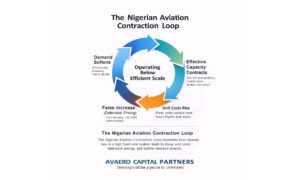
SOLUTONS (3/3): What has to change for domestic aviation to stabilise. If Nigeria wants domestic air travel to become more affordable and predictable, it needs to stop treating high fares as the problem and start treating operating conditions as the constraint. The contraction loop will not be broken by appeals to airlines, and it will not be broken by adding more operators into the same distorted environment. It will break only when the system stops generating avoidable cost and avoidable aircraft downtime.
This is not about returning to some past “normal”. Nigeria’s domestic market has operated with structural instability for years. The task now is to build conditions under which domestic capacity can remain in service, recover from shock, and deliver fares that are consistently more affordable — rather than permanently inflated by disruption, downtime and structural cost.
What breaks the loop is not a single reform. It is a set of linked changes that shift behaviour across the aviation system as a whole.
The system levers that actually change outcomes
1) Keep aircraft in service: maintenance certainty, spares access, AOG speed
The most immediate requirement for stability is keeping aircraft serviceable. That depends on predictable maintenance pathways, reliable access to spares, and fast AOG resolution. When engine shop visits, parts sourcing or payment timing become uncertain, aircraft are withdrawn not out of choice, but because the risk of continued operation becomes unacceptable. Capacity then contracts mechanically, regardless of demand.
Stability is determined less by fleet size on paper than by how many aircraft can be kept flying consistently.
2) De-risk leasing without undermining Cape Town
Aircraft availability is shaped as much by upstream risk perception as by airline intent. When FX delays, payment uncertainty or maintenance cash-flow gaps emerge, lessors respond by tightening terms, shortening tenors or withdrawing flexibility. In some cases, aircraft have been removed from service early, with prepaid costs unrecovered, schedules disrupted and revenue lost.
This is not about weakening Cape Town protections. It is about restoring predictability and trust so aircraft are not pulled from service at the first sign of stress. Stable operations require closer alignment between airline operating realities and lessor risk thresholds.
3) Stop funding inefficiency through charges
Nigeria’s aviation system is heavily funded through charges, fees and levies applied across airports, navigation services and ancillary providers. These mechanisms are often designed for cost recovery, but in a constrained environment they become rigid.
When charges remain fixed while volumes fall, unit costs rise. When inefficiencies persist, costs are carried through the system without correction. This does not always feed directly into airline unit cost calculations, but it raises the operating cost floor and feeds into fare outcomes indirectly through disruption, delays and reduced capacity.
Cost recovery without cost discipline amplifies stress rather than easing it.
4) Make delay costly for the party that causes it
Delays imposed by suppliers — whether in ground handling, fuelling, engineering, customs clearance or navigation — often carry no direct consequence for the source of the delay. The cost is absorbed elsewhere in the system.
This misalignment matters. Where delay carries no consequence, inefficiency persists. Predictable operations require clear accountability, enforceable service standards, and incentives that reward reliability rather than tolerate failure.
5) Fix timing and coordination across agencies
Many constraints in Nigerian domestic aviation are not technical, but procedural. Customs delays, documentation mismatches, agency silos and uncoordinated processes routinely extend aircraft downtime.
These frictions may appear small in isolation, but they accumulate. When timing breaks, capacity breaks. Fixing coordination does not require new policy — it requires operational alignment and escalation pathways that function in real time.
6) Align FX access with operational reality
FX availability affects maintenance payments, spares procurement, leasing confidence and AOG resolution. When FX access is unpredictable or delayed, upstream actors reduce exposure and aircraft are grounded as a precaution.
In a depreciating currency environment, the issue is not only price, but access and timing. When FX cannot be secured when obligations fall due, every delay becomes a shock amplifier.
A practical sequence Nigeria can actually execute
Breaking the contraction loop does not require sweeping reform. It requires sequencing.
First, stabilise maintenance pathways, spares access and AOG response.
Next, restore leasing confidence by improving payment and operational predictability.
Then, remove procedural bottlenecks that keep aircraft grounded unnecessarily.
Finally, ensure that charges and cost-recovery mechanisms do not penalise reliability or reward inefficiency.
When these conditions hold, capacity stabilises. When capacity stabilises, unit costs stop rising mechanically. Only then do fares begin to ease for structural reasons rather than temporary pressure.
The point of leverage
Nigeria’s domestic aviation challenge is not behavioural. It is structural.
The system does not fail because participants lack intent. It fails because shocks are amplified, inefficiencies are tolerated, and costs are repeatedly converted into lower capacity and higher fares.
The task now is to build an operating environment that keeps aircraft in service, absorbs shock without losing capacity, and allows fares to fall because the system is functioning — not because demand is being squeezed.
This is article three in a three part series – related Avaero Insights articles:
Article 1: ANALYSIS: What Nigeria’s Aviation Capacity and Pricing Data Is Really Telling Us
Article 2: DIAGNOSIS: The Nigerian Aviation Contraction Loop
Article 3: SOLUTIONS: Breaking the Nigerian Aviation Contraction Loop
About the Author
Sindy Foster is Principal Managing Partner at Avaero Capital Partners, an aviation advisory firm focused on strategy, economics and operating performance across African and emerging aviation markets.
Her work centres on the structural drivers of airline performance — including capacity, pricing, operational resilience and system design. She advises airlines, investors and public-sector stakeholders on translating operating constraints into sustainable commercial outcomes.
Disclaimer: The insights in this article are for informational purposes only and do not constitute strategic advice. Aviation markets and circumstances vary, and decisions should be based on your organization’s specific context. For tailored consultancy, contact info@avaerocapital.com.