ANALYSIS (1/3): OAG capacity data for December 2025 provides a clear reference point for the supply conditions under which the festive peak unfolded. It shows that Nigeria entered the period with fewer domestic seats available than in December 2024, following a year in which aircraft availability and effective supply had already been under pressure, and even at a time when several peer markets, such as South Africa expanded capacity.
At the same time, domestic airfares rose sharply during the festive peak, generating widespread public reaction. Contemporary reporting from December 2025 shows that one-way domestic airfares that had once been in the range of N50,000–N95,000 earlier in the year were routinely exceeding N300,000 across major routes, with airline executives and analysts attributing the sharp rise to limited aircraft availability, high operating costs, and festive travel pressures.
It is also important to note OAG also reports a smaller contraction in Nigeria’s total (domestic and international) seat capacity in December 2025, reflecting more stable international operations. This analysis focuses specifically on overall domestic capacity, where constraints were more acute. It is also worth noting that capacity reduction was not evenly spread across airlines, and some airlines overall increased seat capacity.
Nigeria Domestic Airline Capacity – December Year-on-Year (OAG)
| Country | December 2024 Seats | December 2025 Seats | YoY Change |
|---|---|---|---|
| Nigeria | 919,400 | 850,420 | –7.5% |
| South Africa | 1,686,956 | 1,803,097 | +6.9% |
Source: OAG Africa Aviation Market Data
Taken together, these outcomes show a domestic aviation system in which supply is being set by operational constraint rather than commercial intent — with aircraft availability and cost structure now determining how much capacity can be offered, and at what price.
How capacity constraints arise
Airline capacity data measures seats offered for sale, not passenger appetite. In practice, it reflects whether airlines are able to operate aircraft reliably, at scale, and with manageable operational risk. Every scheduled seat assumes aircraft availability, predictable maintenance timelines, functioning spares support, and the ability to absorb routine disruption without cascading failure.
In Nigeria, domestic aviation has operated for several years with a persistent gap between nominal fleet size and aircraft actually available for service. Industry disclosures and public reporting have repeatedly pointed to aircraft grounded due to engine life limits, delayed shop visits, spares access challenges linked to FX timing, bird strikes, and maintenance bottlenecks. When these constraints intensify, effective capacity contracts regardless of travel demand. Seats are withdrawn not to manage pricing, but because they cannot be operated reliably at scale.
December 2025: peak travel into reduced supply
By the time the December peak arrived, Nigeria entered the festive season with fewer domestic seats available than a year earlier, following a prolonged period of aircraft and operational pressure. Seasonal demand increased as expected, but airlines were unable to scale capacity meaningfully because operational buffers had already been eroded over the course of the year.
Reporting from the period indicates that some airlines added limited extra frequencies on select routes, while pricing adjusted sharply where aircraft rotations were inefficient, return legs were largely empty, or network imbalance was most acute. In contrast, fares remained more manageable on routes with stronger two-way demand. The result was wide fare divergence across regions, generating public frustration but reflecting the economics of a supply-constrained network rather than arbitrary pricing decisions.
December 2025 therefore combined two conditions that, even independently, would have exerted upward pressure on fares: peak-season demand and lower seat capacity than the previous year. Entering the festive period with fewer available seats meant that prices would have risen even under otherwise normal operating conditions. However, the outcome was further shaped by the cumulative effects of the preceding year, during which airlines had compensated for limited aircraft availability by intensifying utilisation of serviceable aircraft, accelerating maintenance cycles and absorbing higher disruption risk by intensifying utilisation of serviceable aircraft and absorbing higher maintenance costs, disruption-related expenses, fuel price increases, and inefficiencies caused by maintenance delays. When peak demand arrived, it did so in a system already carrying elevated costs and limited buffers, amplifying the pricing effects observed during the period.
What the data is signalling
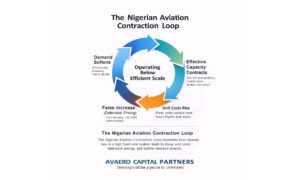
Taken together, the capacity and pricing data point to a domestic aviation system operating below efficient scale. As aircraft availability declined, airlines were required to spread largely fixed and semi-fixed operating costs — including crew, maintenance exposure, handling, insurance, financing and disruption recovery — across a smaller pool of available seats. The arithmetic is straightforward: fewer seats carrying broadly similar cost burdens result in higher unit costs per passenger.
In this environment, fare increases are not an expression of pricing power or opportunism. They are the mechanical outcome of cost recovery in a supply-constrained system. When disruption occurs, there is little surplus capacity to absorb it, so schedules tighten and remaining seats must carry a greater share of the cost base. Pricing therefore adjusts upward not because demand is surging, but because the system is operating below efficient scale and cannot dilute costs through volume.
What this implies going forward
The issue is not the number of airlines in the market, but the conditions under which they are required to operate. Stabilising Nigeria’s domestic aviation market will not be achieved through appeals on pricing or expectations of short-term market correction. As long as aircraft availability remains constrained and operating costs remain structurally high, pricing outcomes will continue to be driven by cost recovery rather than competitive dilution of fixed costs.
Restoring balance requires rebuilding the fundamentals that allow airlines to operate at scale: reliable access to serviceable aircraft, predictable maintenance and spares pathways, improved productivity across airports and service providers, and a cost base that allows fixed and semi-fixed expenses to be spread across a larger pool of available seats. Without these conditions, additional capacity cannot be sustained, and unit costs remain elevated.
Importantly, simply introducing more airlines into a system characterised by the same constraints is unlikely to reduce fares. New entrants are exposed to the same aircraft availability risks, maintenance bottlenecks, cost pressures and disruption dynamics as incumbent operators. In such an environment, increased airline count does not translate into effective competition; it fragments an already constrained supply base and reinforces the same pricing arithmetic.
Until airlines can operate more aircraft more reliably, peak travel periods will continue to amplify existing structural stress rather than resolve it. Pricing will remain a function of constrained supply and elevated unit costs, not of market saturation or demand dynamics.
This is article one in a three part series – related Avaero Insights articles:
Article 1: ANALYSIS: What Nigeria’s Aviation Capacity and Pricing Data Is Really Telling Us
Article 2: DIAGNOSIS: The Nigerian Aviation Contraction Loop
Article 3: SOLUTIONS: Breaking the Nigerian Aviation Contraction Loop
About the Author
Sindy Foster is Principal Managing Partner at Avaero Capital Partners, an aviation advisory firm focused on strategy, economics and operating performance across African and emerging aviation markets.
Her work centres on the structural drivers of airline performance — including capacity, pricing, operational resilience and system design. She advises airlines, investors and public-sector stakeholders on translating operating constraints into sustainable commercial outcomes.
Disclaimer: The insights in this article are for informational purposes only and do not constitute strategic advice. Aviation markets and circumstances vary, and decisions should be based on your organization’s specific context. For tailored consultancy, contact info@avaerocapital.com.